Small Cinema Room Ideas for UK Homes: 8 Layouts That Actually Fit
September 30, 2026
Many small cinema room ideas start with the screen and work backwards. In a genuinely small room, that is often the wrong order.
The room decides where you can sit. Your seating position influences how large the image feels. Only then should you decide what screen size and projector setup make sense.
That matters in UK homes, where a cinema may need to fit inside a box room, loft, spare bedroom, converted garage or shared living room rather than a purpose-built theatre.
The eight layouts below are illustrative examples designed to show how screen wall, seating distance, ceiling shape and furniture affect the setup.
8 Small Cinema Room Ideas for Different Spaces
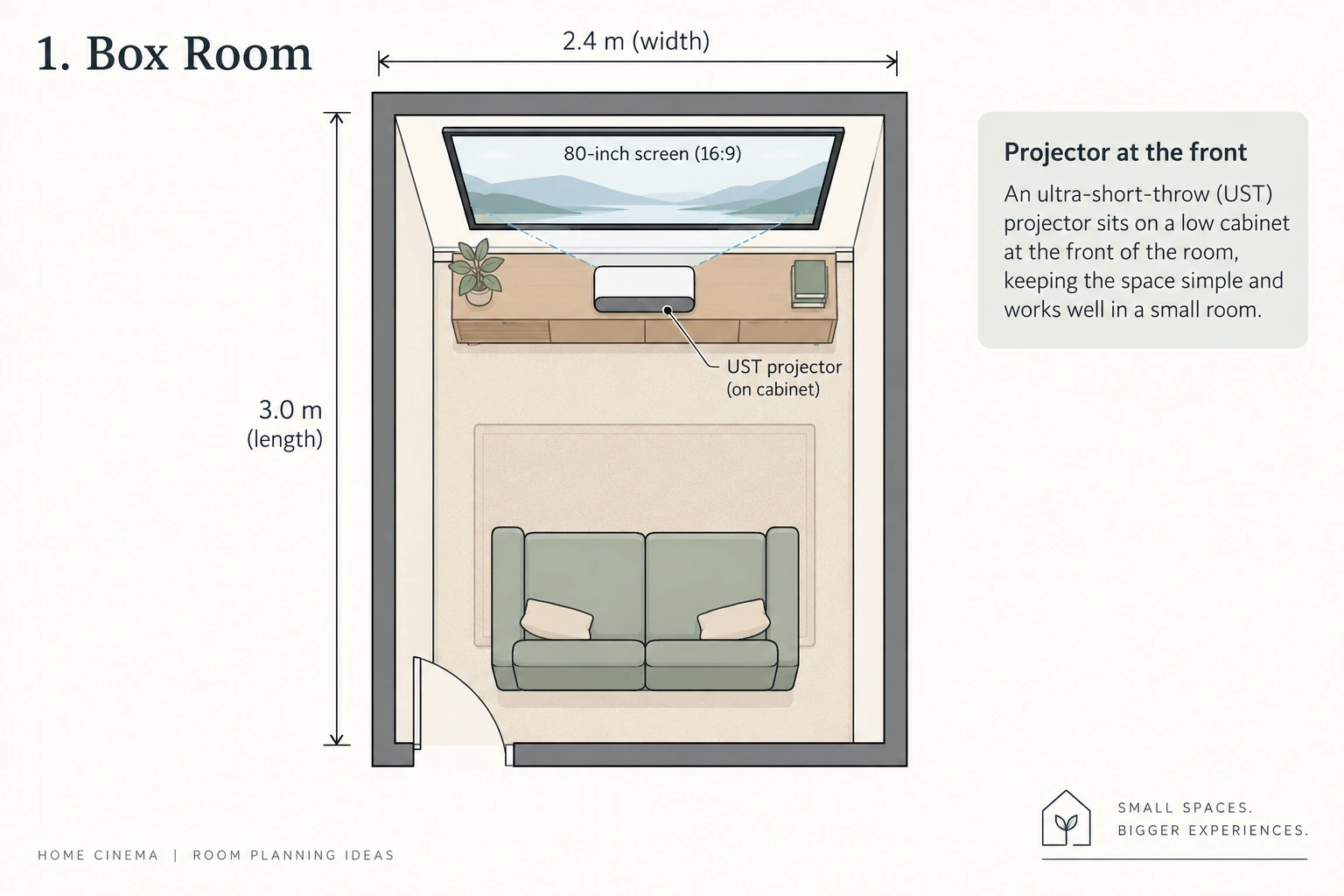
1. A 2.4 × 3.0 m Box Room
A small box room can still work as a cinema, but screen size needs to stay realistic.
An 80-inch 16:9 image is about 177 cm wide, so it fits comfortably on a 2.4 m wall without filling the entire surface.
If your eyes are around 2.0–2.2 m from the screen, an 80-inch picture creates a deliberately immersive viewing angle. That can work well for films and gaming, but it is worth testing before committing.
Minimum image size matters here. Aetherion Max supports 80–200 inches, so 80 inches is already the lower end of its usable range. If your room really calls for a 55- or 60-inch image, a projector in this class is not the right fit.
An ultra-short-throw projector also makes better use of the available floor plan because it sits on a low cabinet near the screen rather than behind the seating.
2. An Under-Stairs Cinema Snug
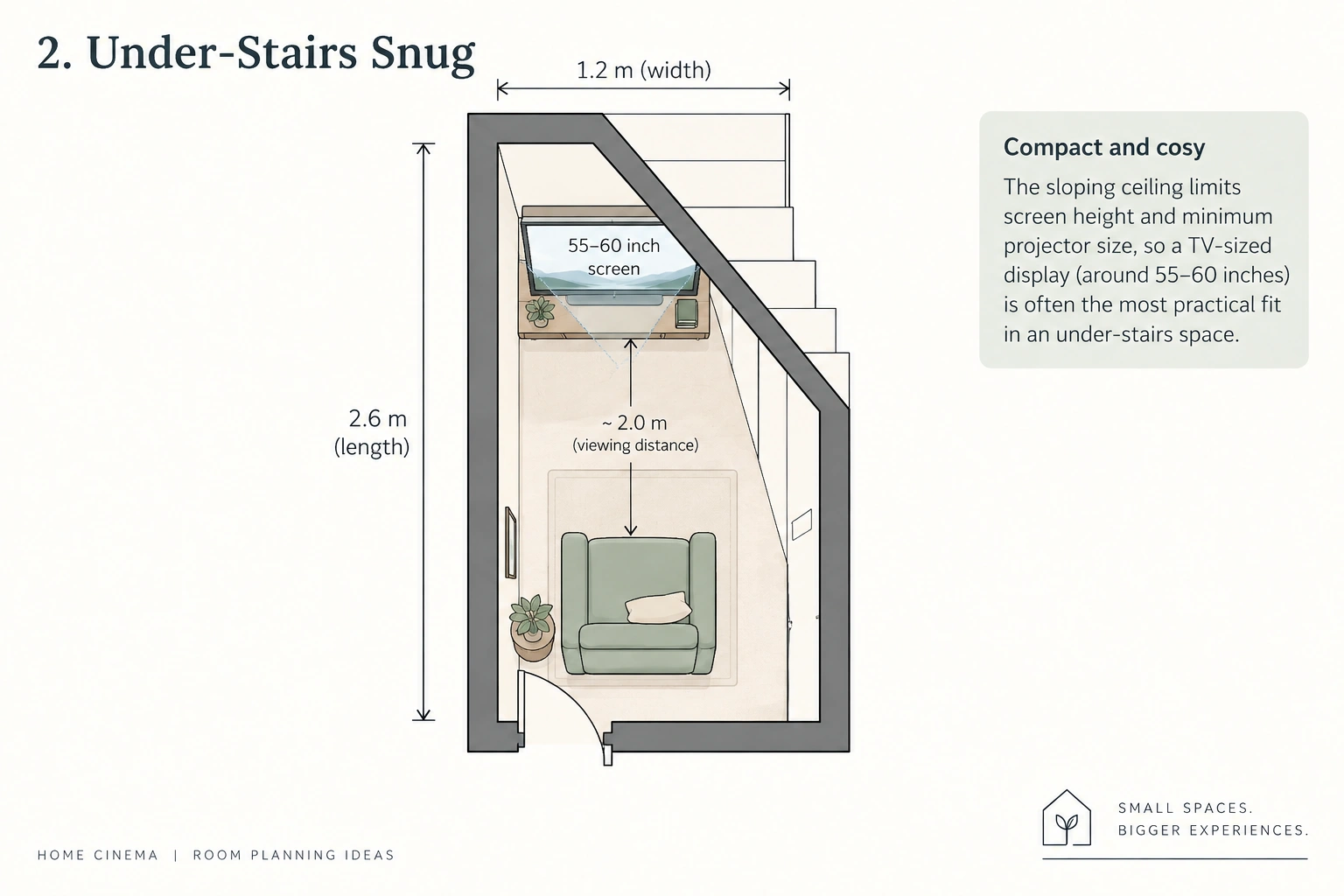
An under-stairs area may feel naturally suited to a cinema, but the descending ceiling usually limits both image width and height.
If the seating is only around 2 m from the end wall and the usable image width is approximately 1.3–1.4 m, the most comfortable screen size may fall closer to 60 inches.
In this kind of space, the right answer may simply be a 55–65 inch television rather than forcing a projector into a layout that is too small.
The lesson is simple: check usable screen height and the projector's minimum image size before buying the equipment.
3. A Loft Cinema with a Sloping Ceiling
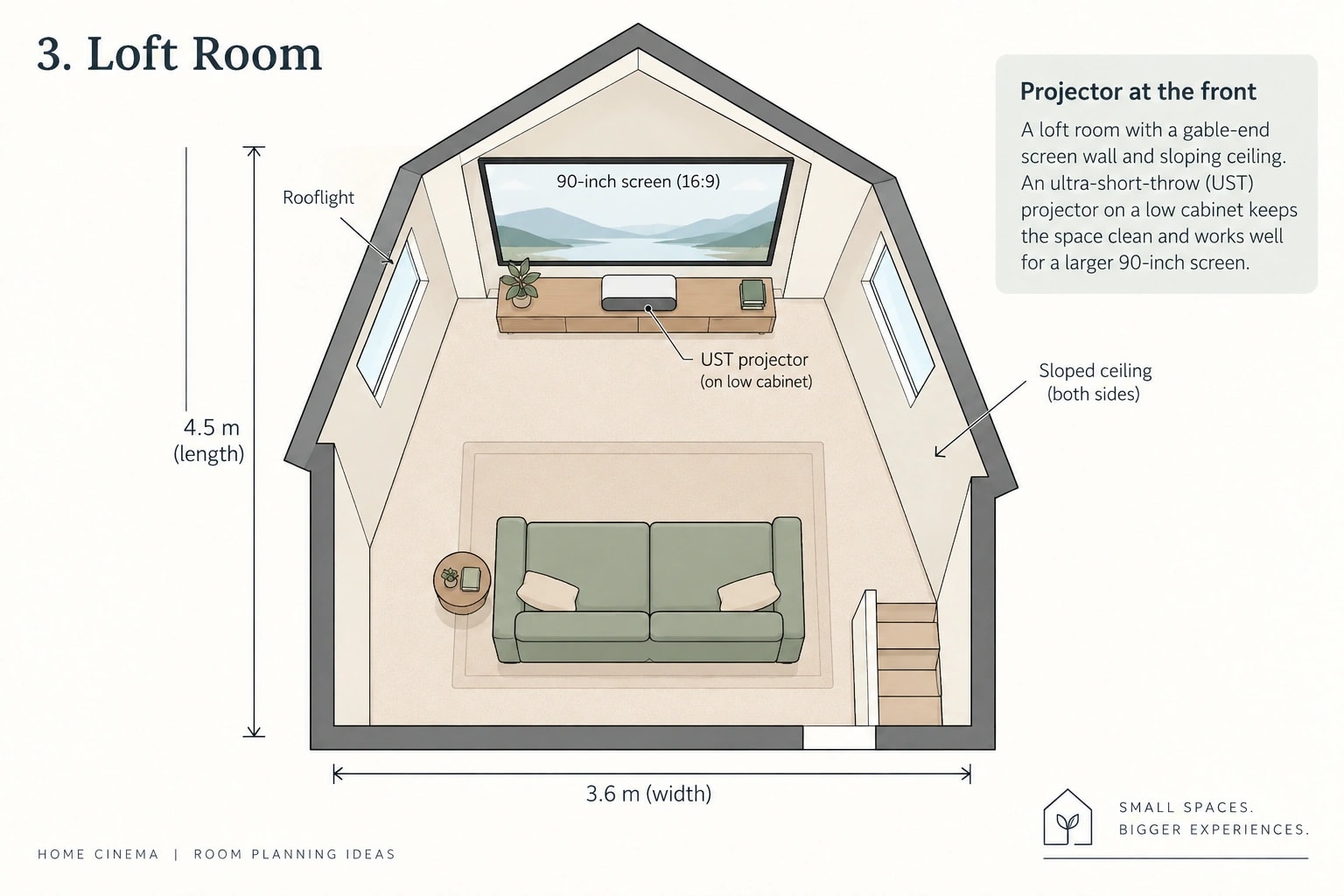
A loft often offers enough viewing distance for projection but creates another problem: projector placement.
The gable wall is usually the strongest screen position because it gives you a full-height vertical surface. A conventional projector may then need to sit or hang where the roof starts to slope, which can make mounting awkward.
An ultra-short-throw projector avoids that issue by staying at the screen end of the room.
In an illustrative 4 × 4 m loft with seating around 3 m from the screen, a picture in the 90-inch range can work naturally without pushing the furniture against the walls.
Blackout treatment for rooflights is also important. Loft rooms can become bright and warm, so light control and ventilation deserve as much attention as screen size.
4. A Garage Conversion
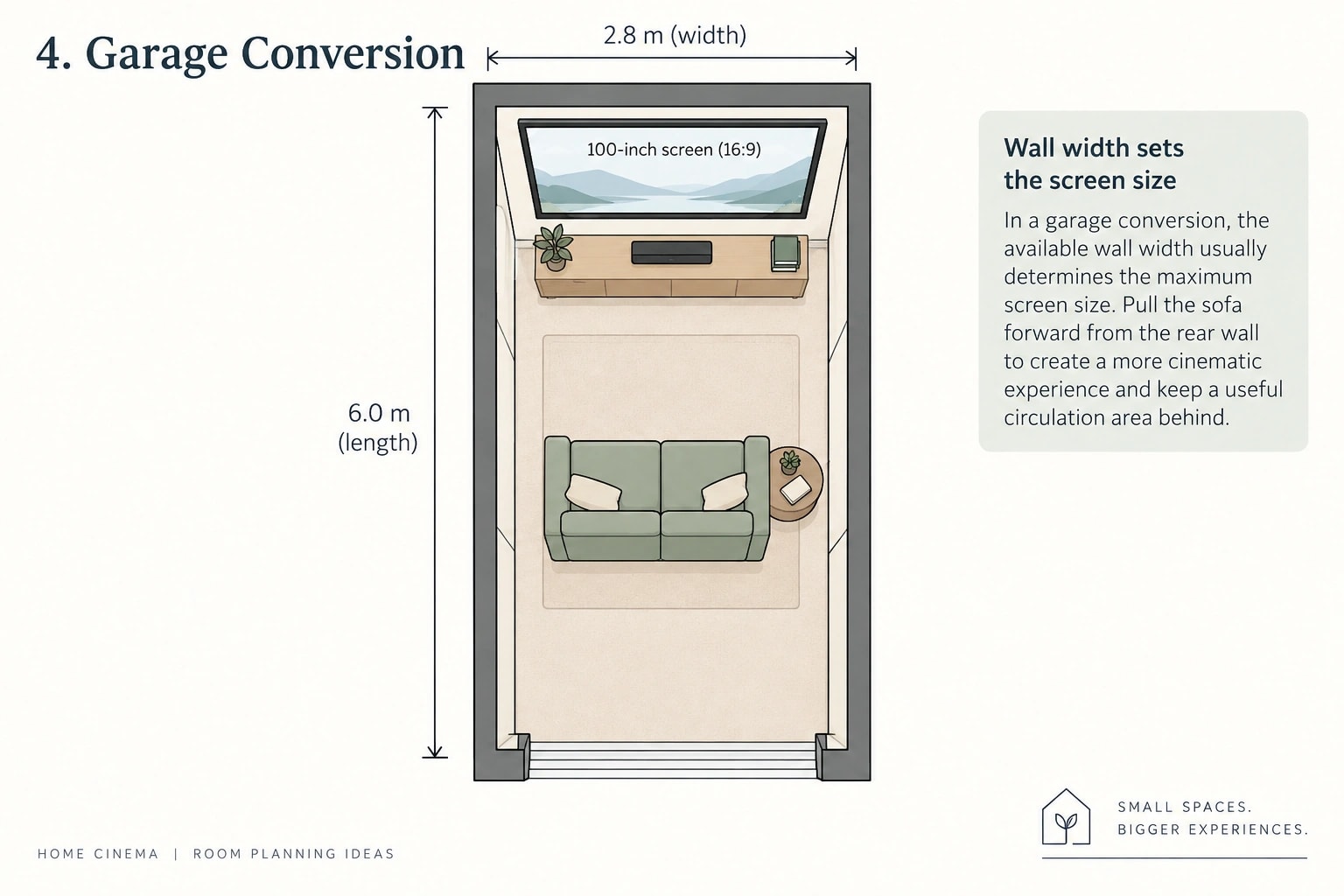
A converted garage may be long, but its width often sets the real limit.
In a room with around 2.6 m of usable internal width, the end wall can comfortably support an image around 100 inches without trying to fill every centimetre.
Do not automatically put the sofa against the opposite wall. In a 5 m-long room, moving the seating forward can make the image feel much more cinematic while leaving useful circulation or storage space behind it.
If the garage itself is being converted into habitable space, deal with insulation, moisture protection, ventilation and electrical requirements as part of the building project before finalising the AV layout.
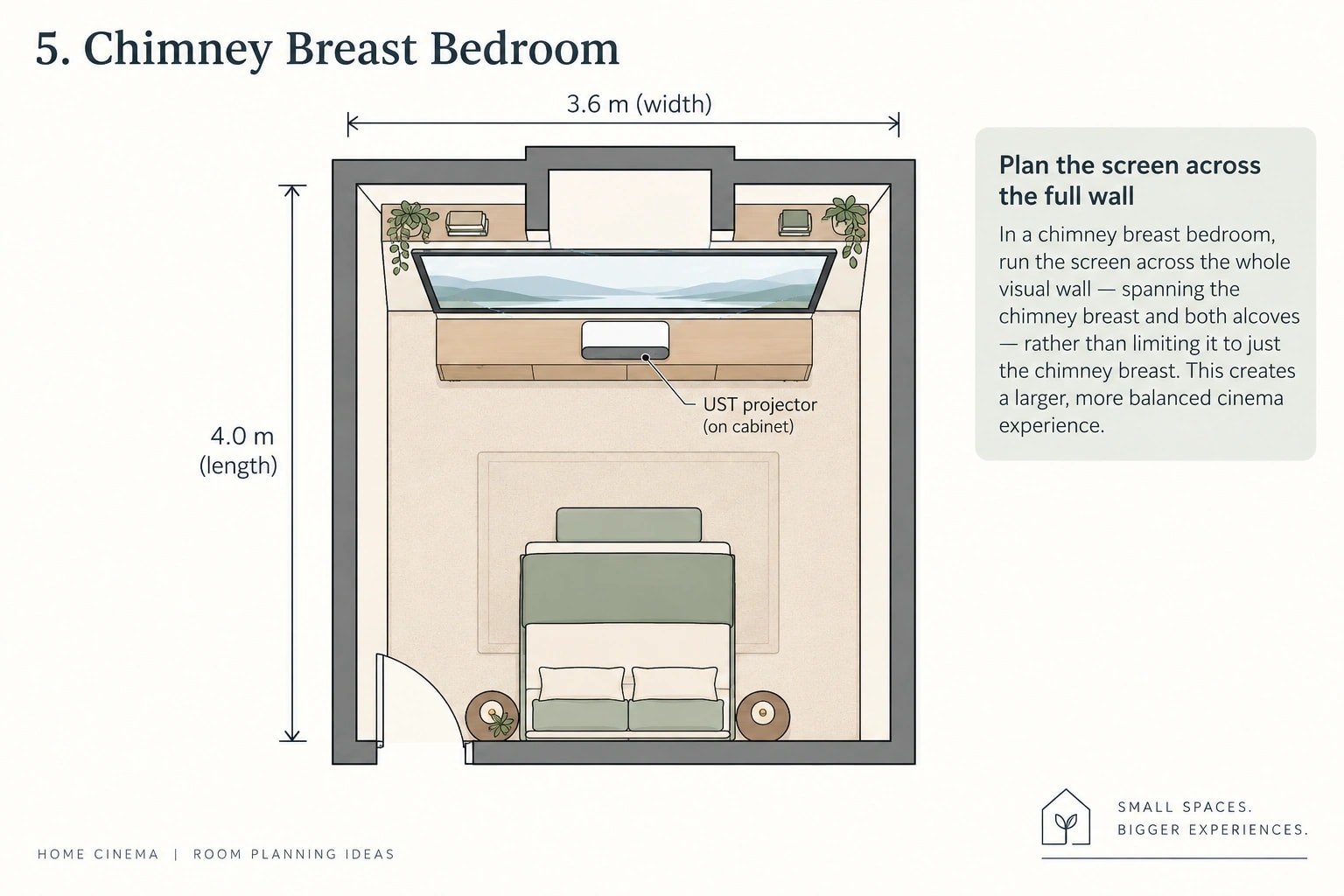
5. A Bedroom with a Chimney Breast
A chimney breast can make a wide wall surprisingly difficult to use.
Instead of trying to fit the picture only onto the face of the chimney breast, a screen can create a flatter visual plane across the wall.
In an illustrative 3.3 × 3.3 m bedroom, an 80-inch image works well with a viewing distance of roughly 2.5–2.8 m.
The important detail is projector placement. Measure from the actual screen plane, not from the original wall behind the alcoves.
Alcoves may be useful for AV components, storage or cable management, but their depth does not automatically equal the correct ultra-short-throw projector position.
6. A Rented Flat with No Permanent Installation
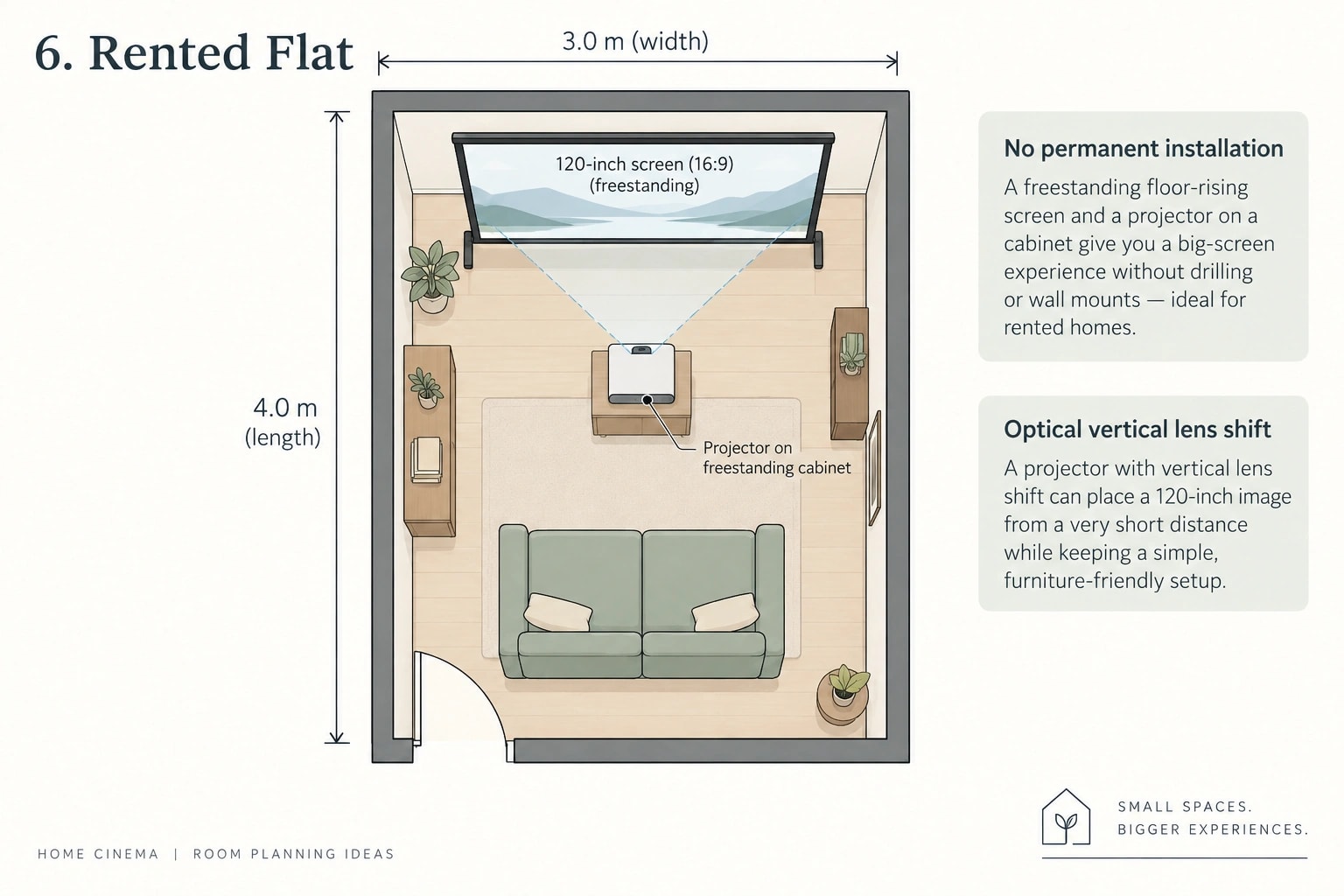
In a rented flat, the biggest constraint may be the tenancy rather than the room.
A floor-rising screen and freestanding projector cabinet can create a large-screen setup without permanently fixing the main components to the wall.
This is also where optical lens shift becomes useful.
LuxVision combines optical vertical lens shift with a 0.18:1 ultra-short-throw ratio, 4K 120Hz, VRR, ALLM and 1 ms input lag at 4K/120Hz. It can produce a 120-inch image from approximately 7.5 inches, or 19 cm, away, giving more flexibility when the screen and furniture are not built permanently into the room.
For a rented setup, that can make fine positioning easier while keeping the whole system reversible.
7. A Through-Lounge for Day and Night Use
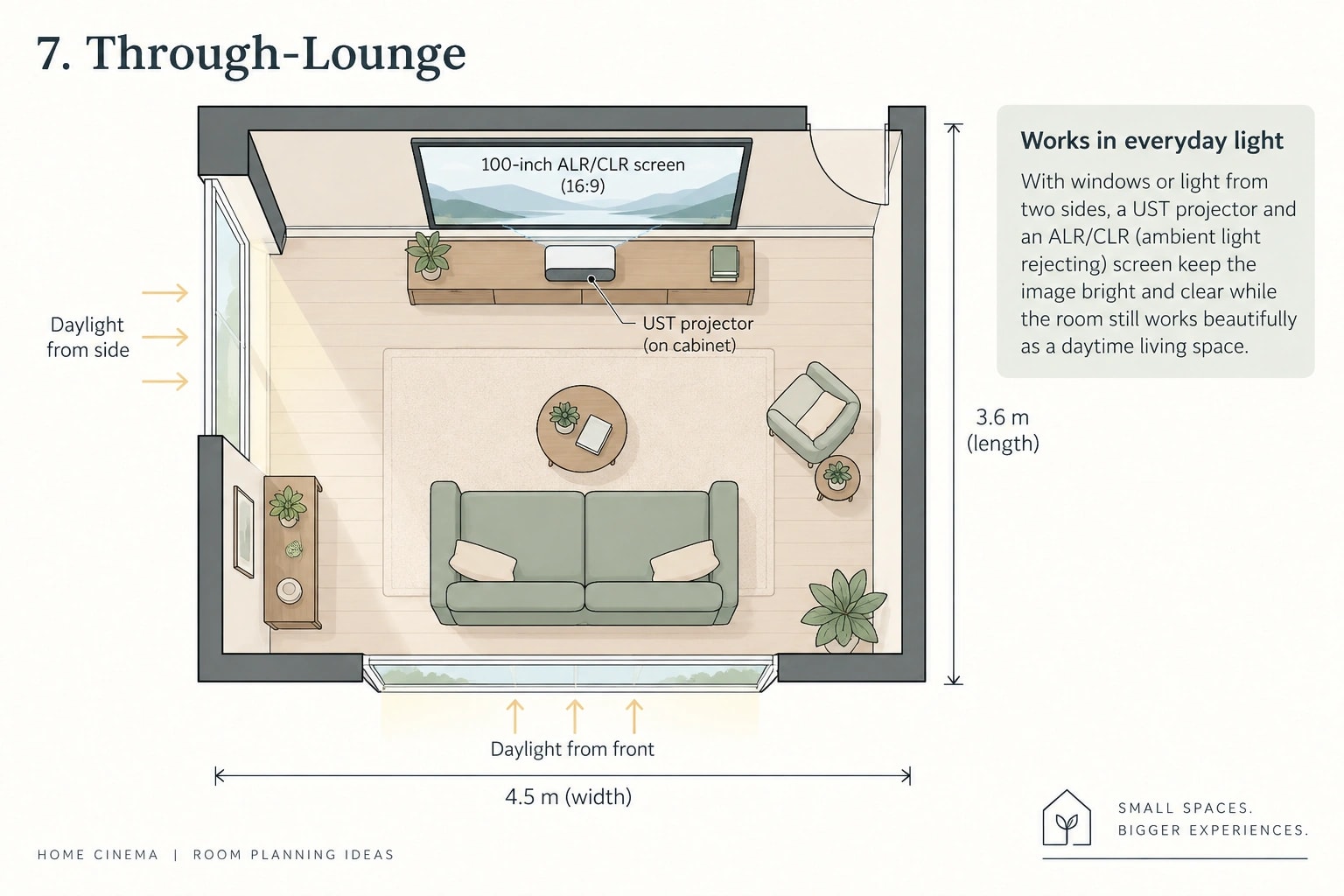
A through-lounge has to work as a living room first and a cinema second.
The screen is usually best placed on an internal wall away from direct window light. Seating should also avoid facing strong reflections where possible.
A UST-specific ALR or CLR screen can improve viewing in ambient light, especially when light comes from above, but it should not be treated as a replacement for blinds or curtains.
Brightness matters too. LuxVision delivers 6,000 ISO lumens, giving it more headroom for shared living spaces where viewing is not limited to a fully darkened room.
The spatial advantage is just as important: a UST projector stays at the screen wall, so there is no projector hanging over the sofa or beam crossing the room.
For a broader comparison, see our Projector vs TV guide.
8. A Spare Room That Doubles as a Guest Bedroom
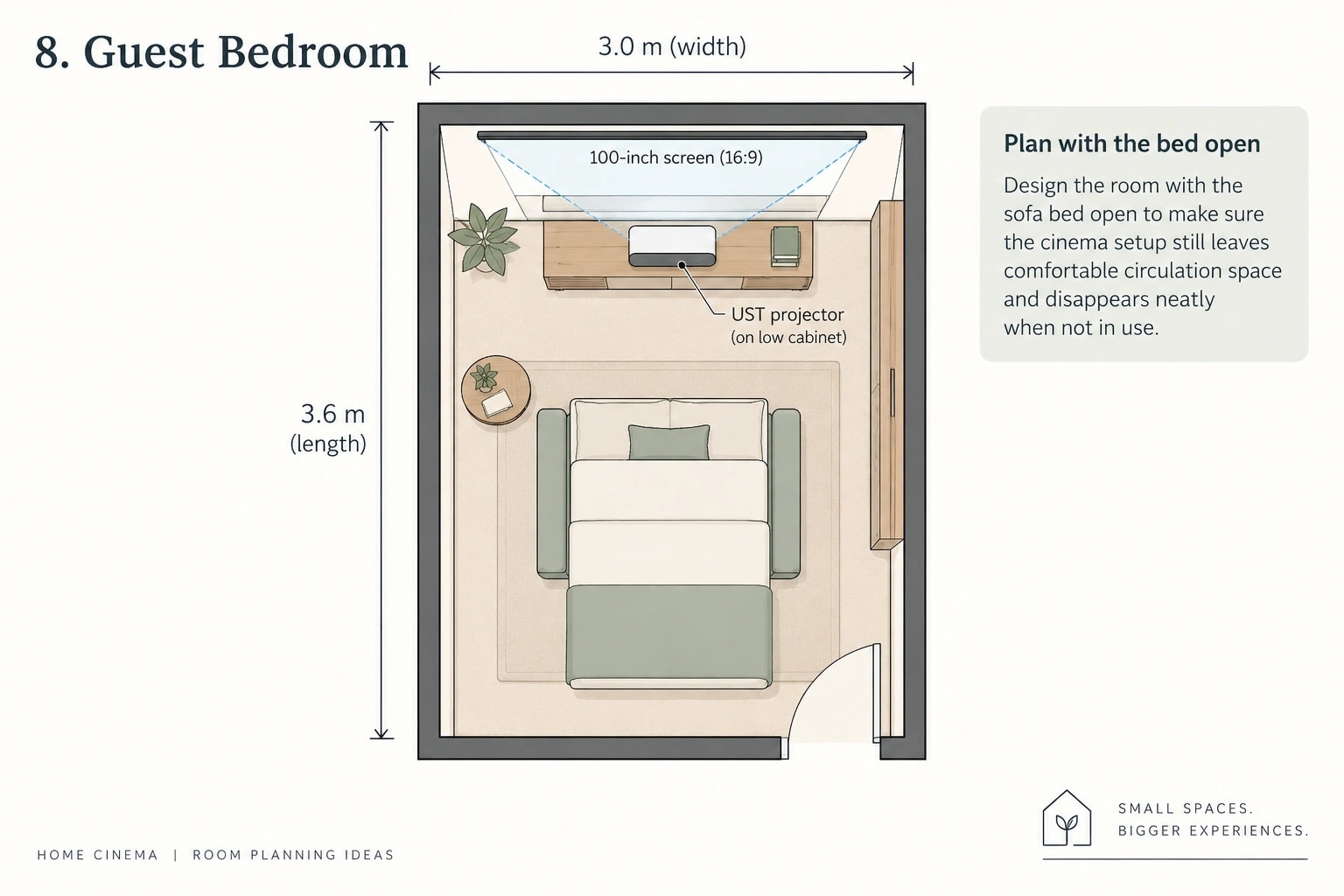
A spare room is one of the easiest places to imagine a home cinema and one of the easiest places to plan badly.
Always draw the layout with the sofa bed open, not folded away.
Check whether you can still walk through the room, whether the bed interferes with the screen area, and whether the viewing position still works.
A floor-rising screen can disappear when guests arrive, while a low projector cabinet can continue working as ordinary furniture.
In a multifunctional room, the most successful setup is usually the one that disappears most easily when the cinema is not in use.
Three Measurements to Take Before Buying a Projector
The room ideas above look different, but almost all of them come back to three measurements.
1. Usable Screen Wall
Measure the actual clear wall after allowing for:
- doors and door swings;
- windows;
- radiators;
- chimney breasts;
- speakers;
- furniture;
- and the screen frame itself.
Do not assume the entire wall can become an image.
2. Eye-to-Screen Distance
Measure from the screen plane to where your eyes will actually be when seated.
Do not simply use the full room length. A sofa can move your eyes 60–80 cm forward from the rear wall.
3. Starting Screen Size
A 36° horizontal viewing angle, commonly used as a cinema reference, gives a useful starting point.
A simple approximation is:
Image width ≈ viewing distance ÷ 1.54
Then multiply the width by roughly 1.15 to estimate the diagonal of a 16:9 screen.
Treat that as a reference rather than a hard rule. Some viewers prefer a more immersive image.
Most importantly, compare the result with the projector's supported image range. If your ideal size is 60 inches and the projector starts at 80 inches, that is a specification mismatch rather than an installation problem.
Where Should the Projector Sit?
A conventional projector usually needs ceiling space, a rear shelf or enough throw distance behind the seating.
In a short room, those positions can become awkward.
An ultra-short-throw projector keeps the hardware at the front of the room, which is why it works particularly well in box rooms, bedrooms, lofts and multifunctional spaces.
One detail is worth understanding: throw ratio is not the same as rear-wall clearance.
For Aetherion Max, the published placement dimensions are approximately:
- 100-inch image: 15.8 cm from the wall to the rear of the projector;
- 150-inch image: 36.2 cm;
- 200-inch image: 56.7 cm.
These figures exclude the projector body itself, which is approximately 32.3 cm deep.
So a 100-inch setup occupies roughly 48 cm from the wall to the front of the chassis before any extra allowance for cables or ventilation.
Use these installation dimensions when choosing a cabinet rather than trying to calculate rear-wall clearance from the 0.2:1 throw ratio alone.
Small Cinema Room Changes That Make the Biggest Difference
You do not need to rebuild the room to improve it.
Focus first on the changes that affect picture quality and usability most:
- control strong daylight with blinds or curtains;
- use matt finishes around the screen to reduce reflections;
- position seating for the image instead of automatically pushing it against the rear wall;
- add rugs, curtains and fabric furniture where the room sounds too reflective;
- test subwoofer placement rather than assuming a corner is always best;
- keep projector, source devices and cabling together in one simple cabinet.
Small rooms benefit more from thoughtful layout than from adding more equipment.
Planning and Building Regulations
If you are simply adding a projector, screen and furniture to an existing room, planning approval is normally not part of the project.
The situation changes if you are creating a new habitable room.
For example, in England, garage and loft conversions may fall within permitted-development rules in some cases, but Building Regulations can still apply. Electrical work must also comply with Part P where relevant.
Rules differ across England, Wales, Scotland and Northern Ireland, so check the requirements that apply to your property before starting structural or electrical work.
What to Do Next
Plan the room in this order:
- Choose the screen wall.
- Measure your real eye-to-screen distance.
- Estimate a sensible screen size.
- Check that size against the projector's supported range.
- Check the actual installation dimensions.
- Then choose the cabinet, screen and seating.
If the room supports an 80-inch image or larger, an ultra-short-throw projector can remove one of the biggest compromises in a small cinema room: the need to place the projector behind or above the viewer.
Explore the 4K Laser TV range to compare current models, or see How to Make a Home Cinema for the wider room-planning process.
Discover More Insights